Of all the personal finance concepts I taught as a beginning teacher, marginal versus effective tax rate was one of the most frustrating for my students (and me). It is not surprising, however, because from the adults I have discussed it with, tax brackets are also the source of an absurd yet confidently wrong assumption. The misconception that your marginal tax rate is what you pay in taxes is so widespread, and so stubbornly persistent, that it really makes one wonder if that is the point. After a few years of trying—and, to be honest, in many ways failing—to explain this effectively enough to get even half of the class to understand, I think I have finally gotten there.
It does boggle the mind however. One assumes that people can look at their income and what they owe in taxes, calculate the percentage and see that they are actually paying less (in most cases much less than the marginal tax rate. However, there are deductions, tax credits, different filing statuses, and a whole bunch of other considerations that can vary depending on someone’s situation, including whether they have multiple sources and types of income. However, discussing any of that with students before they have mastered how tax rates actually work will only make an already confusing concept even more confusing. The goal here is to understand the brackets first. The complications can come later.
Teacher Tip: The biggest problem I have encountered with students, however—and I blame “new math” (aka common core)—is that most, yes, and I mean most, of my high school students do not fully understand what a percentage is nor how to calculate one. If you too are having trouble teaching certain personal finance concepts like interest, APR, tax rates, etc., it is worth looking into with an anonymous math check.
Step 1: What Is a Tax Bracket?
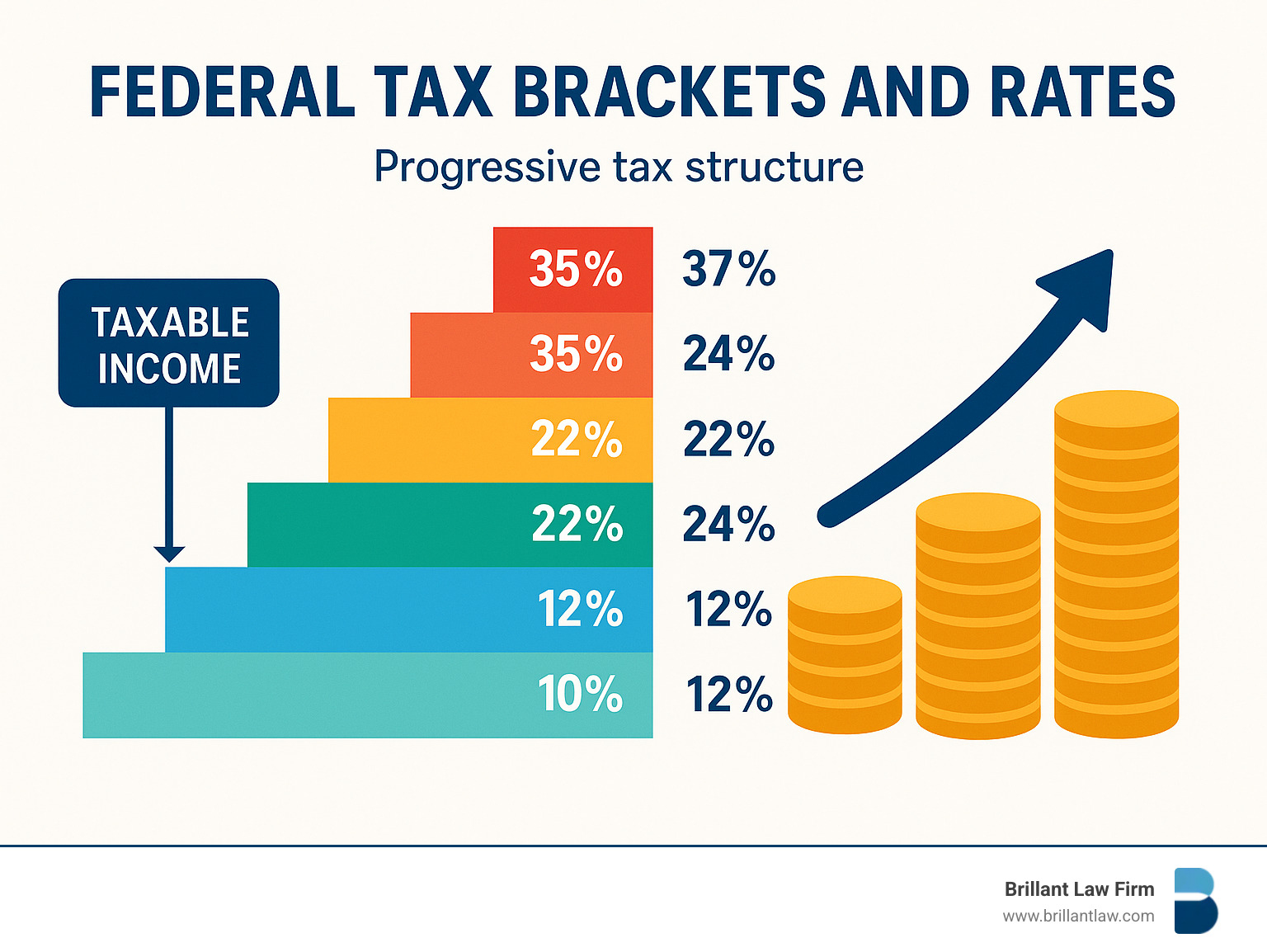
The United States uses a progressive income tax system. Progressive (progressive in the financial sense, though the general idea works politically as well) simply means that as your taxable income increases, additional dollars may be taxed at higher rates. In other words, the more money you make, the higher the tax rate can become on the top portion of your income.

The federal government divides taxable income into ranges (a range is a span of numbers from a lower one to a higher one)—called tax brackets—and assigns a tax rate (%) to each range of numbers. The key word there is range. Each rate applies only to the dollars that fall within that specific range, not to your total income.
For Example: Imagine a very simplified federal tax system had has only three brackets:
| Income Range | Tax Rate |
| $0 – $50,000 | 10% |
| $50,001 – $100,000 | 20% |
| $100,001 and above | 30% |
Now let’s say you earn $100,000 in a year. Here is the question most people answer incorrectly: How much federal income tax do you owe? Hint: It is not $20,000, which is the most common assumption. Their reasoning goes: “I’m in the 20% bracket, so I have to pay 20% of $100,000.”
Here Is How It Actually Works
If you think about it for a second, it makes perfect sense. If it were as simple as finding your bracket, then someone who made $50K would have to pay $5,000 in taxes, but someone who made $50,100 would suddenly have to pay more than $10,000. Obviously, that would be the opposite of fair.
Instead, what happens is that the person who makes $50K owes 10% of that $50K in taxes, or $5,000. The person who makes $50,100 also pays 10% on the first $50K, or $5,000, plus 20% of the additional $100. So they pay $5,020.
Think of It Like Buckets
So if you make $210,000 using our fictitious brackets, your money gets divided up and each piece gets taxed at the rate that applies to that specific piece. Think of it like filling up buckets—each bucket has its own rate, and you fill each one before moving to the next.

- Bucket 1: The first $50,000 of your income falls in the 10% bracket.
$50,000 × 10% = $5,000
- Bucket 2: The next chunk of your income—from $50,001 to $100,000—falls in the 20% bracket. That’s $50,000 worth of income.
$50,000 × 20% = $10,000
- Bucket 3: The remaining income—from $100,001 to $210,000—falls in the 30% bracket. That’s $110,000 worth of income.
$110,000 × 30% = $33,000
Now add those three numbers together:
$5,000 + $10,000 + $33,000 = $48,000
- That is your federal income tax bill in our simplified example—$48,000, not $63,000 (30% of $210,000).
Two Numbers Worth Knowing: Marginal Rate vs. Effective Rate
This is where two terms come in that are genuinely useful to know and frequently confused with each other.
Your marginal tax rate is the rate applied to your next dollar of taxable income. In our example above, your marginal rate is 30%, because additional income would fall into the 30% bracket. When people say someone is “in the 22% tax bracket,” they are referring to the marginal rate. This does not mean 22% is what they pay on all of their income.
Your effective tax rate * is the actual percentage of your total income that went to taxes when you add it all up. In our example:
So even though this person is “in the 30% bracket,” they are actually paying an effective rate of about 23%*—because $48,000 ÷ $210,000 = 22.86%, and only a portion of their income gets taxed at 30%. The rest was taxed at lower rates. Your effective rate is almost always lower than your marginal rate, often significantly so.
* Deductions, including the standard deduction or itemized deductions, reduce the amount of income that is actually subject to federal income tax before the bracket math begins. So in this simplified examples, we are pretending that the full income amount is taxable and ignoring deductions and credits in order to focus on how the brackets themselves work. This is also why someone’s effective tax rate—the percentage of their total income that they actually pay in federal income tax—is usually much lower than their marginal tax rate.
Why This Misconception Matters
Being financially literate about one’s taxes is important, even if taxes are frustrating, tedious, and probably no one’s favorite thing to think about. Accountants make mistakes—mine certainly have—and so does the IRS (twice now for me) and the software we rely on, including programs like TurboTax and QuickBooks. None of the people or systems we trust to look out for our financial interests are infallible, which is why understanding the basics yourself is a form of financial self-empowerment.
But on a more practical note, this misconception can have very real consequences. Before I became a teacher, I worked as an HR manager, and I once had an employee tell me he did not want the raise he had just been offered because he had “looked into it” and believed it was going to push him into a higher tax bracket–so he would actually being making less money. That experience has always stuck with me because it showed me that misunderstanding how tax brackets work can have real financial consequences.
His assumption is wrong in almost every case. Under a progressive marginal tax system, moving into a higher federal income tax bracket by itself will not cause you to take home less money. Only the dollars above the bracket threshold get taxed at the higher rate. The dollars below that line continue to be taxed exactly as they were before.
Three important caveats worth mentioning, especially if you are teaching this:
1 – What we have been discussing is federal income tax only. State income taxes vary widely—some states have no individual income tax, others have their own progressive brackets, and some use a flat rate.
2 – This only applies to federal income taxes. There are also payroll taxes. Employees generally pay Social Security tax on earnings up to an annual limit ($184,500 in 2026), while Medicare tax has no maximum earnings limit. Different types of income, such as long-term capital gains, can also be taxed under different rules and rates. A complete picture of someone’s total tax burden involves much more than federal income tax brackets.
3 – Finally, the numbers we used here are highly simplified for illustration. The real federal system has more brackets, the dollar thresholds differ based on filing status (single, married filing jointly, head of household, etc.), and deductions and credits can significantly change what someone actually owes. The standard deduction, for example, reduces the amount of your income that is subject to tax before the bracket math even begins.
Tax planning often focuses on strategically reducing taxable income—the income the bracket math gets applied to—not on avoiding brackets themselves.
Possible Activity for Students
The bucket analogy tends to land well with high schoolers—filling one bucket before it spills into the next is intuitive. As a class activity, have students actually calculate the tax on a sample income using a bracket table. The arithmetic is not complicated—it is just multiplication and addition—and the act of doing it themselves tends to dislodge the misconception in a way that explaining it verbally sometimes cannot.


Leave a Reply